As one of the foundations and keys to scientific and technological innovation, the development, application and forming process research of new materials have become the focus in numerous fields. Frontiers of Materials Research: A Decadal Survey, issued by the US National Academy of Sciences in 2019, pointed out that high-entropy alloys will be one of the most promising research topics in the next decade [1]. The concept of high-entropy alloys (HEAs) was first proposed independently by Prof. Yeh Jien-Wei from Taiwan, China, and Prof. Cantor from the UK in 2004. Compared with traditional alloys with limited principal elements [2–4], the HEAs they proposed consist of five principal elements at near-equiatomic ratios, with each principal element ranging from 5 at.% to 35 at.%, featuring highly uniform chemical composition. Instead of forming massive intermetallic compounds despite multiple principal elements, HEAs mostly present a single solid-solution structure, such as body-centered cubic (BCC), face-centered cubic (FCC), or hexagonal close-packed (HCP) [5].
With the deepening research on compositional design and preparation of HEAs, HEA materials with diverse properties have been developed by adding different elements. For instance, the addition of Cr, Fe, Co, Ni and other elements tends to form FCC-phase HEAs, which usually exhibit high yield strength [6–14]; while the incorporation of refractory metals (Nb, Mo, Ta, W, etc.) generates BCC-phase HEAs. Such HEAs typically inherit the characteristics of refractory metals, featuring higher melting point, strength, hardness, wear resistance and oxidation resistance [15–21], and are thus defined as refractory high-entropy alloys (RHEAs). RHEAs show outstanding performance under various extreme working conditions, meeting the manufacturing demands of key components in modern aerospace engines, nuclear reactors, high-temperature and high-speed turbines, etc., with broad application prospects.
The earliest RHEAs were two equiatomic RHEAs (WNbMoTa and WNbMoTaV) prepared by Senkov and his team [6] using Nb, Mo, Ta, W, V as principal elements via vacuum arc melting (VAM). Early RHEA fabrication mostly adopted the VAM method. However, this method fails to fully address the challenges for the industrial application of RHEAs due to defects such as low cooling rate, severe segregation, high energy consumption, and strict limitations in plasticity and forming dimension. Meanwhile, additive manufacturing has been increasingly widely applied, and selective laser melting (SLM), proposed by the Fraunhofer Institute for Laser Technology in Germany in the 1990s, has attracted extensive attention from researchers. The layer-by-layer regional melting and stacking forming logic of SLM greatly reduces the forming cost and cycle of complex components. Meanwhile, its high precision, high cooling rate and the high temperature provided by laser match well with the characteristics of RHEAs, showing great potential in the forming and manufacturing of RHEA-based components.
From the perspective of composition, this paper classifies RHEAs into two major categories, and systematically summarizes the current research status of alloy composition optimization and forming process optimization of SLM for RHEAs.
1 Overview of SLM Technology
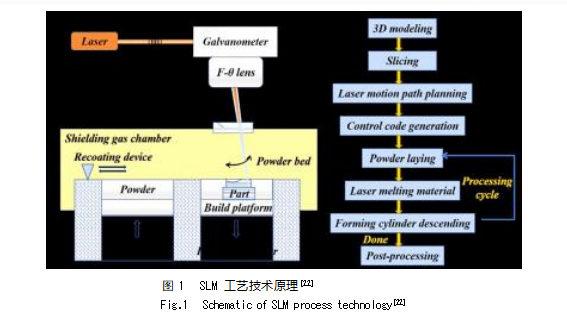
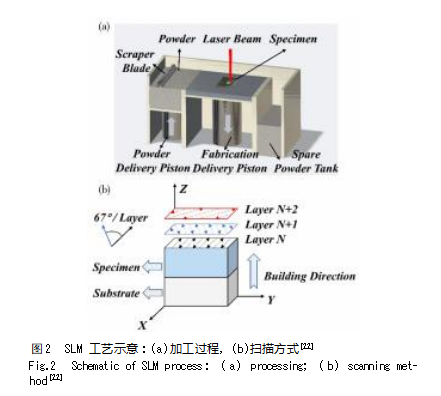
As one of the metal-oriented additive manufacturing technologies, the SLM forming process is shown in Fig. 1 [22] and Fig. 2 [22]. Firstly, the powder spreading roller pushes metal powder onto the substrate to form a flat powder bed, and the laser scans the specific area of the powder bed to melt the powder for forming; then the substrate is lowered to reduce the height of the powder bed, and the powder spreading roller lays a new layer of metal powder above the solidified layer; next, selective laser melting is performed according to the pre-sliced data, and the new layer fuses and bonds with the printed layer. This stacking process is repeated until the component is completely fabricated.
Compared with traditional component forming processes, SLM has four core advantages for complex components:① Strong processing flexibility. SLM is not restricted by part geometry and dimension. The layer-by-layer stacking method greatly reduces the manufacturing cost of complex structures (curved surfaces, porous structures, lattice structures, etc.), realizing die-free machining of complex parts and eliminating the mold manufacturing process.② High forming precision. SLM-fabricated parts generally have high precision. When using metal powder with small particle size and high sphericity, interlayer bonding strength is further improved, enhancing the mechanical properties and internal densification of formed parts.③ Low production time cost. SLM adopts layer-by-layer selective melting and stacking, eliminating traditional steps such as mold and fixture fabrication and process flow design, thus greatly shortening the production cycle of metal components.④ Excellent product performance. The ultra-fast cooling rate of the SLM melt pool refines the solidified microstructure, endowing the formed metal parts with excellent comprehensive mechanical properties and high densification.
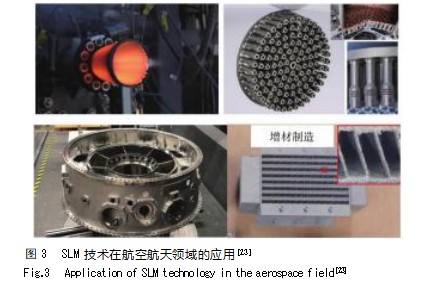
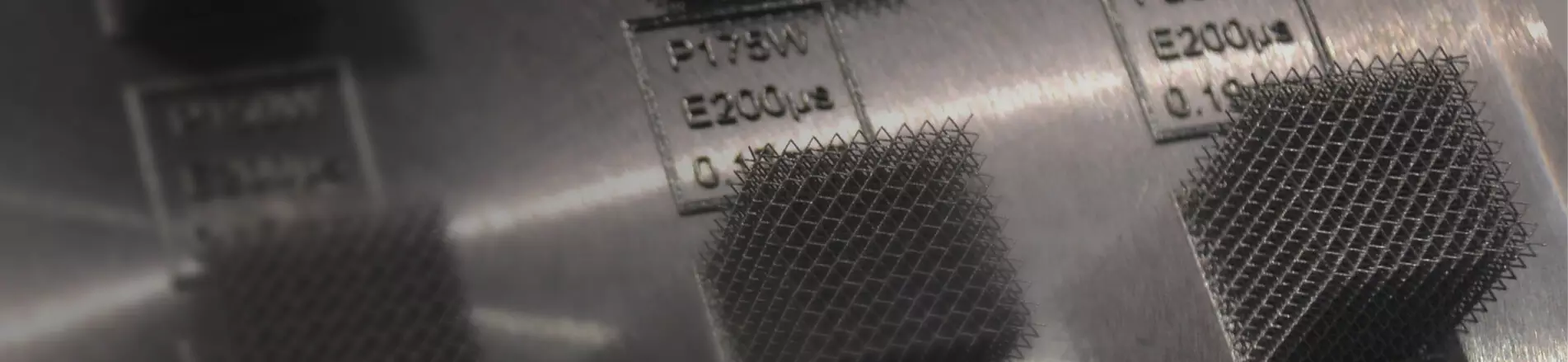
With the four advantages of strong flexibility, high precision, low time cost and excellent mechanical properties, SLM has been applied to fabricate many key complex metal components in aerospace, biomedicine and other fields, realizing the integrated forming of numerous complex assemblies, as shown in Fig. 3 [23].
2 HEA Powder for SLM and Issues in Composition Selection
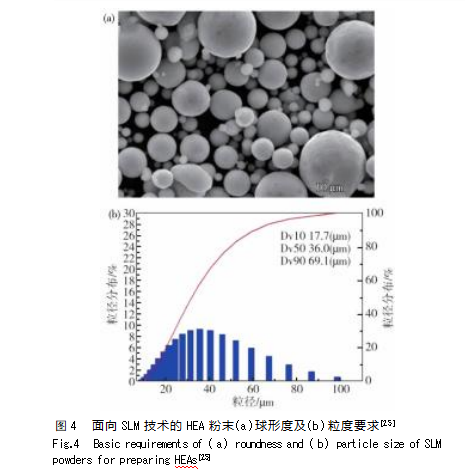
The optimal particle size of HEA powder for SLM is 5–50 μm, with requirements of narrow particle size distribution, good flowability and high sphericity. At present, HEA powder for SLM is mostly prepared by atomization, mainly including gas atomization, water atomization and centrifugal atomization.Gas atomization works by breaking molten metal flow into fine droplets under high-speed gas, which then solidify into metal powder. The prepared powder features high purity, large average particle size, good sphericity and high apparent density, but the cost and utilization rate are disproportionate.Water atomization shares a similar mechanism with gas atomization, except that water is used as the atomizing medium; the powder has small particle size but low flowability and sphericity.Centrifugal atomization works by dropping molten metal through a nozzle into a rotating cylindrical container, breaking the melt into droplets under centrifugal force, which then solidify into powder. The particle size is related to the rotating speed, with wide distribution, low hollow powder ratio and low cost [24].
Research by Ding et al. [25] in 2017 showed that HEA powder prepared by atomization has high sphericity and purity, uniform composition and few impurities, which is highly compatible with SLM. As shown in Fig. 4, they revealed the requirements of SLM on the sphericity and particle size of HEA powder. Meanwhile, the high solidification rate during gas atomization can improve the solid solubility of principal elements and suppress the precipitation of secondary phases.
Based on the design philosophy of high-entropy materials, Wang Xiaopeng et al. [26] classified HEAs into five categories: RHEAs, high-temperature HEAs, transition-element HEAs, amorphous HEAs and eutectic HEAs. Fig. 5 summarizes the crystal structure and mechanical properties of HEAs for laser melting technologies.
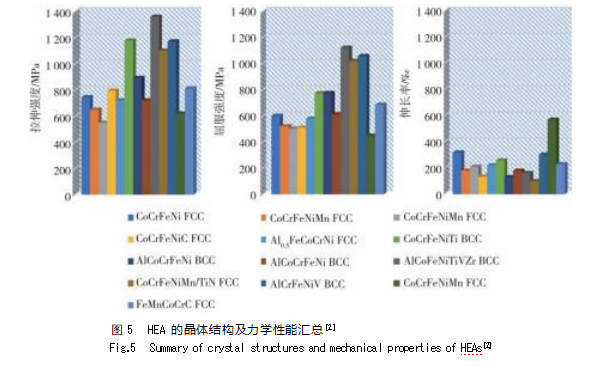
In terms of composition, common principal elements of RHEAs for SLM include Co, Fe, Al, Ni, Ti, etc., with distinct properties.
Co promotes the formation of FCC phase inside the alloy, improves ductility and strength, and prevents segregation [27].
Fe improves the ductility and lattice distortion of the alloy, affects the transformation of FCC HEA grains from dendritic to equiaxed, reduces the strength of FCC HEAs and causes magnetization [28].
Al enhances the strength and corrosion resistance of HEAs under passivation conditions.
Ni, when added within the critical stoichiometric ratio (x = 1), enables HEAs to retain FCC structure and show optimal corrosion resistance in neutral and alkaline environments. When the addition exceeds the critical ratio, Ni reacts with Al to form Al-Ni-rich B2 intermetallic compounds, which degrade the corrosion resistance of HEAs.
Ti significantly improves the corrosion resistance of some HEAs and may induce intermetallic compounds [29].
Mo aggravates lattice distortion, strengthens solid-solution effect, increases alloy strength but reduces ductility, and raises the melting point and yield strength of Moₓ-(Nb₃TaTi₃Zr)₁₀₀₋ₓ RHEAs [30].
Utah State University (US) first launched research on SLM-fabricated RHEAs [31]. Based on first-principles and over 400 HEA design criteria, researchers explored novel HEAs containing four types of elements (transition metals, lanthanides, rare earths, high-melting-point metals) and their SLM forming, and successfully fabricated several new AlCoFeNiSmTiVZr HEAs via SLM. Most of these HEAs present a single-phase FCC structure with excellent mechanical and corrosion resistance.
In 2019, Zhang et al. [32] from Xi’an Jiaotong University successfully prepared NbMoTaW RHEA via SLM, controlling the atomic content of each principal element within 5%–35%. The grains were significantly refined compared with traditional casting, and the strength, hardness and corrosion resistance of the alloy were improved. However, composition deviation existed between the printing powder and the printed sample, which was speculated to be caused by large differences in melting point, density, particle size and energy absorption rate among alloy components.
3 Composition Optimization of SLM-Fabricated RHEAs
Among the widely concerned HEA systems, RHEAs with refractory metals as principal elements exhibit excellent room- and high-temperature performance, showing broader application prospects. Refractory metal components in RHEAs mainly refer to metals from Groups VB to VIIB in the periodic table, with melting points above 2000 ℃ and abundant natural reserves, such as Ta, Nb, W, Mo, Re, etc. [33–34]. Refractory alloys can be obtained by taking them as principal elements and adding auxiliary alloying elements. The high-melting-point characteristic expands the aerospace application of RHEAs. In addition, high mixing entropy and lattice distortion effects endow such alloys with better mechanical properties and stability.
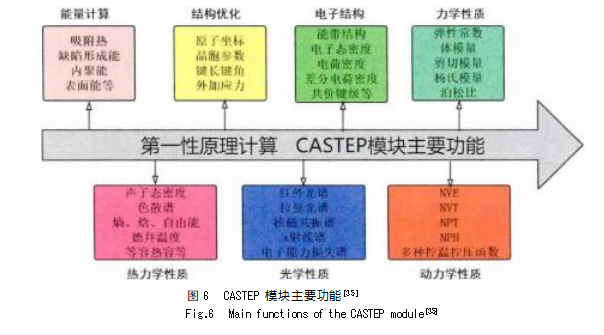
Composition research of RHEAs is mostly based on first-principles calculation (ab initio method) derived from density functional theory (DFT). It imports the number and position of modeled atoms as calculation parameters, and solves the Schrödinger equation by approximating the basic laws of quantum mechanics and microscopic particle motion. First-principles can realize crystal structure optimization and system energy calculation without relying on past design experience or semi-empirical parameters, analyze the properties and performance of the alloy system, and thus guide alloy composition design.
Alloy design software based on first-principles includes CASTEP, VASP, Gaussian, etc.
VASP solves the Schrödinger equation via self-consistent iteration, with wide applicability and potential functions for most elements.
CASTEP, like VASP, is based on DFT and plane-wave pseudopotential method, showing outstanding advantages in composition design and performance prediction of metals, ceramics and metal-ceramic composites.
Gaussian is mainly used for organic macromolecular systems, with low compatibility for heavy-metal-containing alloy systems (as shown in Fig. 6 [35]).
Using first-principles, Tian et al. [36] explored the effects of different alloying elements on the electronic structure of TiZrVNb and TiZrNbMoVₓ RHEAs, and predicted the temperature resistance of Mo-containing RHEAs via density of states and partial density of states.Ge et al. [37] combined the quasi-harmonic Debye model and EMTO-CPA method to study the thermodynamic properties of ternary and quaternary RHEAs containing Al, Ti, V, Cr, Nb and Mo, and found that elevated temperature enhances the anisotropy and ductility of the alloy.Mu et al. [38] investigated the elastic constants and anisotropy of multiple RHEA systems: TiZrVMo, TiZrVMoTa, TiZrVMoTaNb, TiZrVMoTaNbCr, TiZrVMoTaNbCrW.
3.1 NbMoTaW‑X Series RHEAs
As the first reported HEA composed entirely of refractory elements, NbMoTaW alloy has long been a typical representative of RHEAs. It features outstanding high-temperature resistance and maintains a stable BCC structure even at 1400 ℃. Current research on NbMoTaW-X alloys is mostly at the experimental stage.
On the effects of metallic elements on NbMoTaW RHEAs:Han et al. [39] added Ti to NbMoTaW-X HEAs and studied its influence on lattice constant, density, microstructure and compressive mechanical properties. Results showed that Ti addition, driven by lattice distortion and solid-solution strengthening from atomic size mismatch, can improve the strength and ductility of RHEAs while retaining the BCC solid-solution structure.Zang et al. [40] added Re as an alloying element into NbMoTaW HEA to prepare NbMoTaWReₓ RHEAs, and found that appropriate Re content improves strength and ductility; NbMoTaWRe₀.₅ shows the optimal mechanical properties among different Re contents.Zhao et al. [41] added Cu into NbMoTaW HEA to prepare a series of gradient-thickness Cu/(NbMoTaW) HEA films, and revealed the relationship between film thickness, hardness and dislocation strengthening mechanism. High misfit dislocation density at the interface can significantly increase the hardness of Cu/(NbMoTaW) RHEA films.Bai Linhui [35] explored the alloying strengthening effects of low-melting-point elements (Ti, V, Cr, Zr) and high-melting-point elements (Hf, Re) on NbMoTaW-X RHEAs via first-principles and experiments. Results showed that low-melting-point elements (Zr, V, Ti, Cr) improve room-temperature strength and ductility, among which Ti and Zr show remarkable effects, boosting strength and ductility to 2000 MPa and 16%, respectively. Reducing Mo content improves the strength-toughness of NbMoTaW alloy; with the increase of Mo and W content, alloy hardness rises (400HV–800HV), while strength and ductility decrease.
On non-metallic elements:Guo Zhiming et al. [42] studied the effect of Si on the high-temperature tribological properties of NbMoTaW RHEAs, and found that Si addition significantly improves the yield strength, compressive strength and fracture strain at room temperature, and enhances wear resistance at 25–800 ℃.In 2020, Wu Shiyu [43] from Dalian University of Technology investigated the effect of C on the crystal structure, mechanical properties, microstructure and comprehensive performance of NbMoTaW RHEAs. Carbon was introduced via ceramic particles to develop second-phase strengthened alloys: NbTaW₀.₅(Mo₂C)ₓ, NbTaW₀.₅TiCₓ, NbTaW₀.₅Hf₀.₂₅Cₓ. Among them, NbTaW₀.₅(Mo₂C)₀.₂ shows excellent performance, with yield strengths of 1026 MPa (1473 K) and 697 MPa (1673 K); NbTaW₀.₅Hf₀.₂₅C₀.₂5 exhibits yield strengths of 868 MPa (1273 K), 792 MPa (1473 K) and 749 MPa (1673 K), far exceeding previously reported RHEAs.Wan et al. [44] explored the effect of nitrides on NbMoTaW RHEAs, and found that increasing nitride content refines grains and significantly improves strength.
3.2 NbMoTa‑X Series RHEAs
Cao Yuankui et al. [45] studied the effects of Al and Mo on the high-temperature oxidation behavior of NbMoTa RHEAs using TiNbTa₀.₅Zr, TiNbTa₀.₅ZrAl and TiNbTa₀.₅ZrAlMo₀.₅ alloys. Results showed that Al addition forms a dense oxide film and improves oxidation resistance, while Mo addition destroys the protective film. Thus, the oxidation rate of TiNbTa₀.₅Zr and TiNbTa₀.₅ZrAl is diffusion-controlled and follows exponential oxidation kinetics, while TiNbTa₀.₅ZrAlMo₀.₅ shows severe oxidation film cracking and porosity, leading to sharply degraded oxidation resistance.
Yu Sheng et al. [49] explored the effect of Ta content on the high-temperature oxidation performance and mechanism of NbMoTa RHEAs. Ta content is positively correlated with the slow-diffusion effect; increasing Ta suppresses oxygen diffusion and reduces the proportion of volatile oxide-enriched zones, thus enhancing high-temperature oxidation resistance. Meanwhile, the stable and dense Ta oxide film reduces the cracking tendency of NbMoTa RHEAs.
On non-metallic elements:A joint team from China and Japan led by Yao Yuhong [50] studied the effect of B on the high-temperature oxidation performance of NbMoTa RHEAs. The exothermic peak intensity of AlMo₀.₅NbTa₀.₅TiZrBₓ RHEAs dropped from 0.95 W/g (B-free) to 0.05 W/g, and the oxidation peak temperature rose from 880 ℃ to 1020 ℃. Appropriate B addition alleviates oxide scale spallation during short-term oxidation, forming protective complex oxides (Nb₄Ta₂O₁₅, AlNbO₄) after 50 h oxidation at 800 ℃, greatly improving oxidation resistance at 800 ℃ for 3 h and 50 h.
4 Process Optimization of SLM-Fabricated RHEAs
Senkov et al. [16, 51] prepared Nb₂₅Mo₂₅Ta₂₅W₂₅ and V₂₀Nb₂₀Mo₂₀Ta₂₀W₂₀ RHEAs via VAM, both showing single BCC phase—the earliest reported preparation and research of NbMoTaW RHEAs.Subsequently, Zhang et al. [32], Gu et al. [52] and Huber et al. [53] successively fabricated NbMoTaW, VNbMoTaW and WMoTaNbV RHEAs via SLM. Compared with VAM counterparts, SLM-fabricated alloys only contain BCC phase but with much finer grains:
Zhang et al. [32]: SLM NbMoTaW, lattice parameter aᵢ = 3.2134 Å, average grain size 13.4 μm (VAM: ~200 μm).
Gu et al. [52]: SLM VNbMoTaW, aᵢ = 3.1658 Å, close to VAM theoretical value.
Huber et al. [53]: SLM WMoTaNbV, average grain size 16.3 μm (VAM: ~80 μm).
The finer grains in SLM samples are attributed to:① Large temperature gradient and undercooling during SLM, which accelerate nucleation and restrict grain growth.② Ultra-high cooling and solidification rate, which suppress atomic diffusion and grain coarsening [54–57].
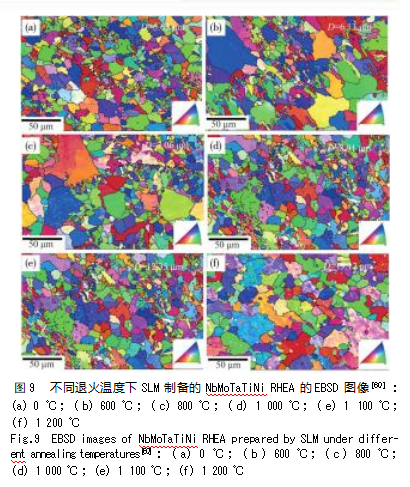
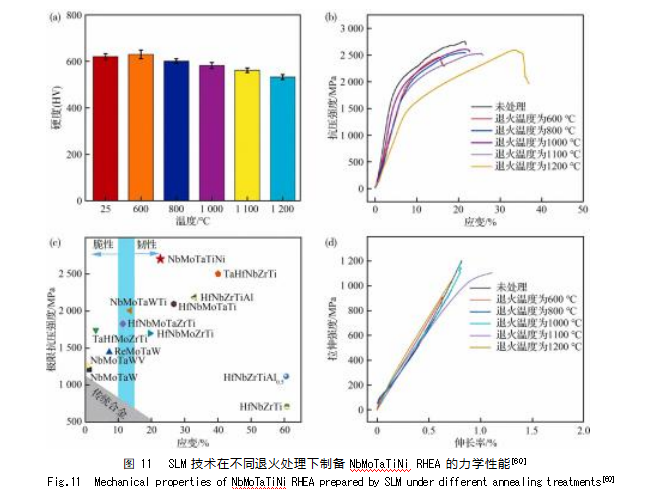
Current process optimization for SLM-fabricated RHEAs mainly focuses on parameter optimization and post-heat treatment, including laser power, scanning speed, hatch spacing, layer thickness and volumetric energy density.
4.1 NbMoTaW‑X Series RHEAs
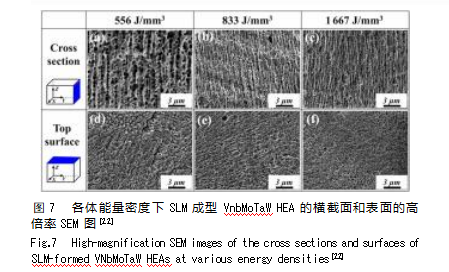
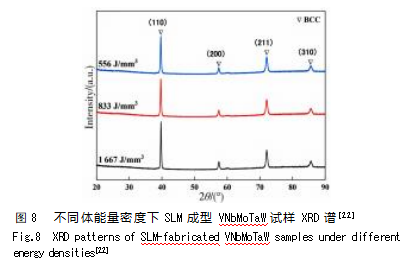
Gu Pengfei [22] used VNbMoTaW pre-alloyed powder to fabricate single-phase solid-solution VNbMoTaW RHEAs via SLM, and summarized the influences of SLM parameters on macro/microstructure and properties, establishing the functional relationship among volumetric energy density, microstructure and mechanical properties. High volumetric energy density improves surface quality, reduces internal defects, refines grains and lowers residual stress, leading to higher micro-hardness, compressive strength and high-temperature oxidation resistance. At 1200 ℃, the oxide layer directly forms ternary oxides without intermediate transition.In 2022, Gu et al. tested micro-hardness at three scanning speeds (400, 600, 800 mm/s): HV719.81, HV648.94, HV602.58. 400 mm/s was determined as the optimal speed, with compressive strength of 2154 MPa.
Wang Fanqiang [58] optimized SLM parameters for spherical WMoTaNbV RHEA powder. The optimal parameters were: laser power 450 W, scanning speed 200 mm/s, hatch spacing 90 μm, layer thickness 30 μm, volumetric energy density 833.3 J/mm³. Compared with cast samples, SLM samples show better mechanical properties: micro-hardness 707.64HV, ultimate compressive strength 1702.3 MPa, plastic strain 8.1%.
5 Conclusion
At present, in terms of composition optimization, metallic elements (Ti, Al, etc.) and non-metallic elements (C, Si, etc.) exert positive effects on NbMoTa and NbMoTaW series RHEAs.In terms of process optimization, compared with traditional VAM, research on SLM-fabricated RHEAs is relatively limited, but existing studies confirm that SLM produces RHEAs with finer grains, more uniform composition, better mechanical properties and corrosion resistance.
However, challenges still exist in SLM fabrication of NbMoTa and NbMoTaW RHEAs, such as poor formability and severe cracking caused by excessive residual stress. In addition, with the popularization of multi-laser SLM equipment and the increasing demand for integrated large-scale components in aerospace, the mechanical properties and microstructure of the lap zone between different laser beams during multi-laser SLM of RHEAs remain insufficiently studied, leaving a huge exploration space.、
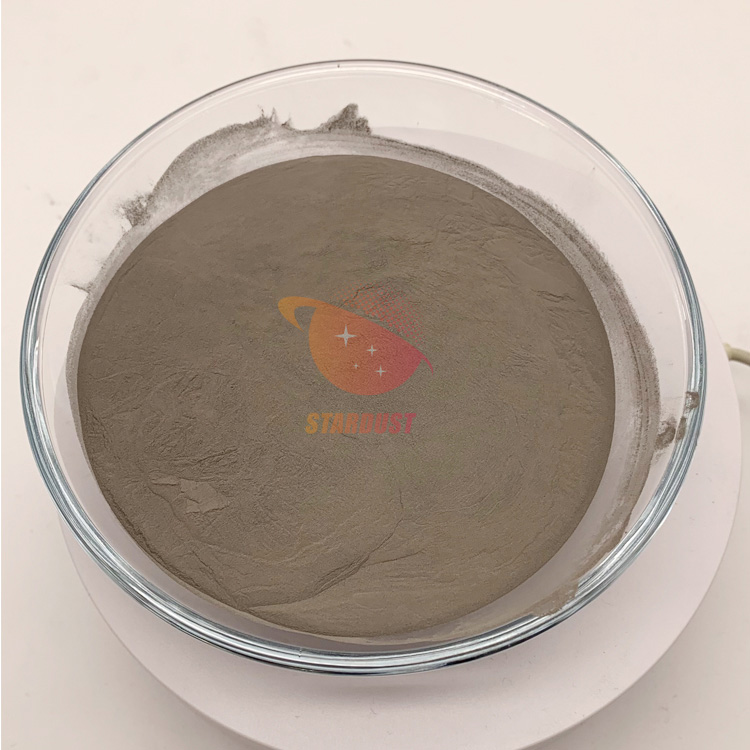
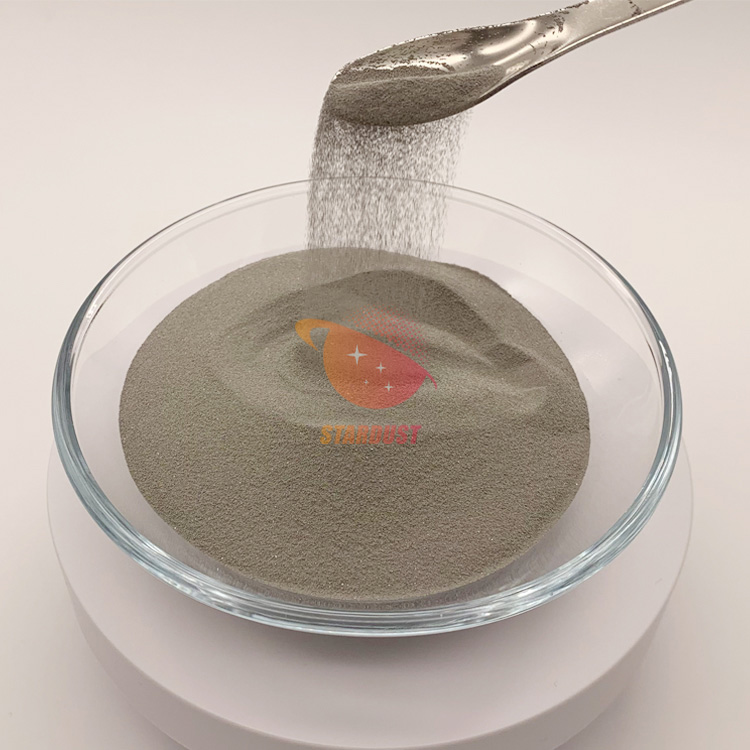
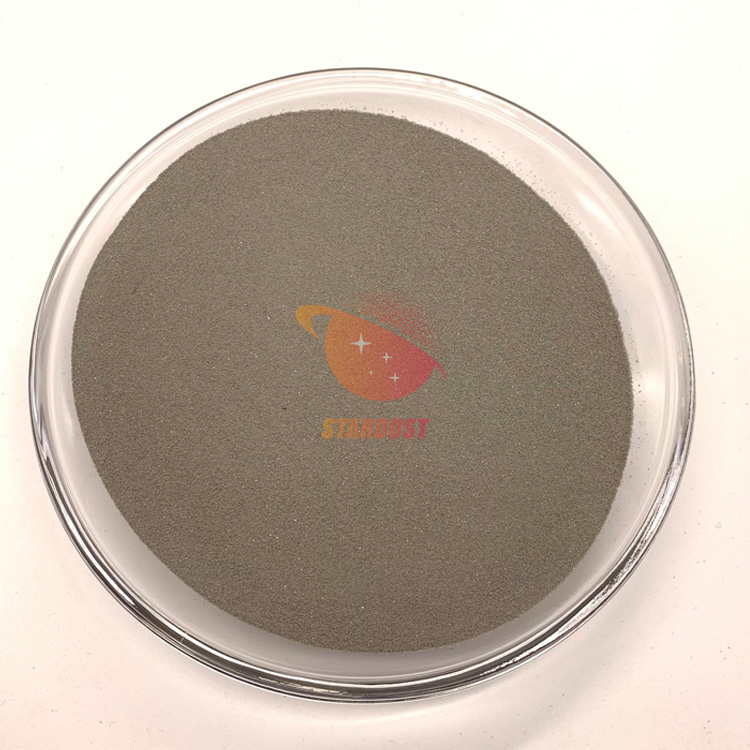
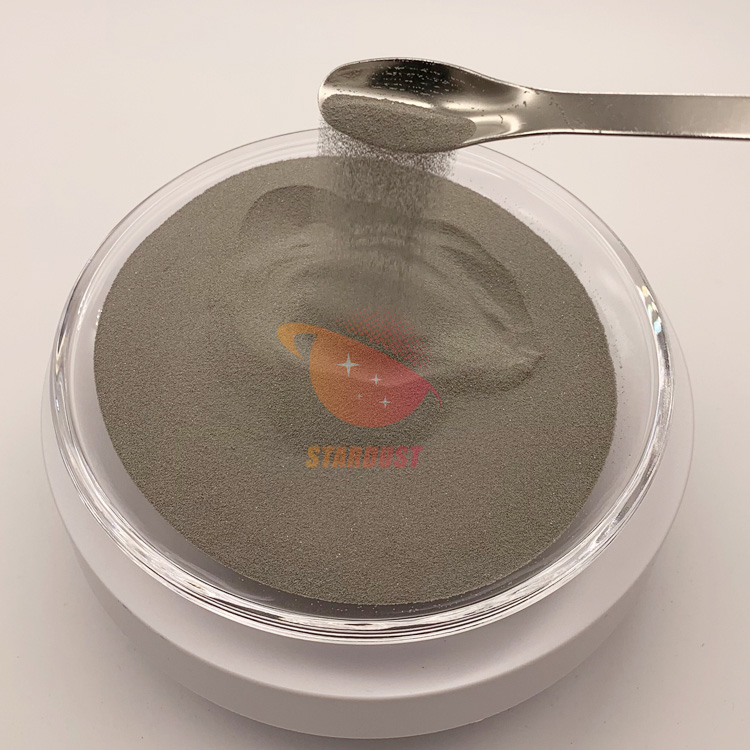
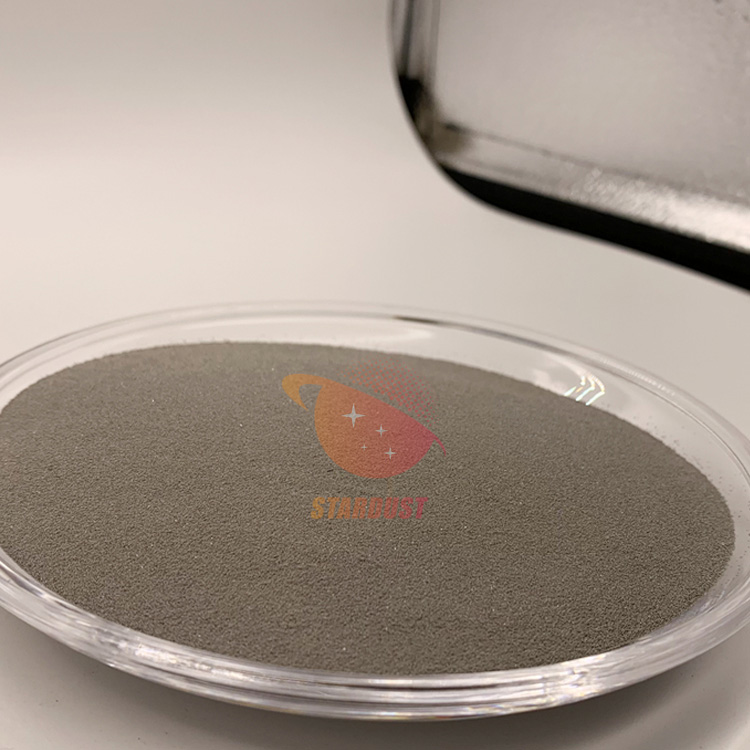
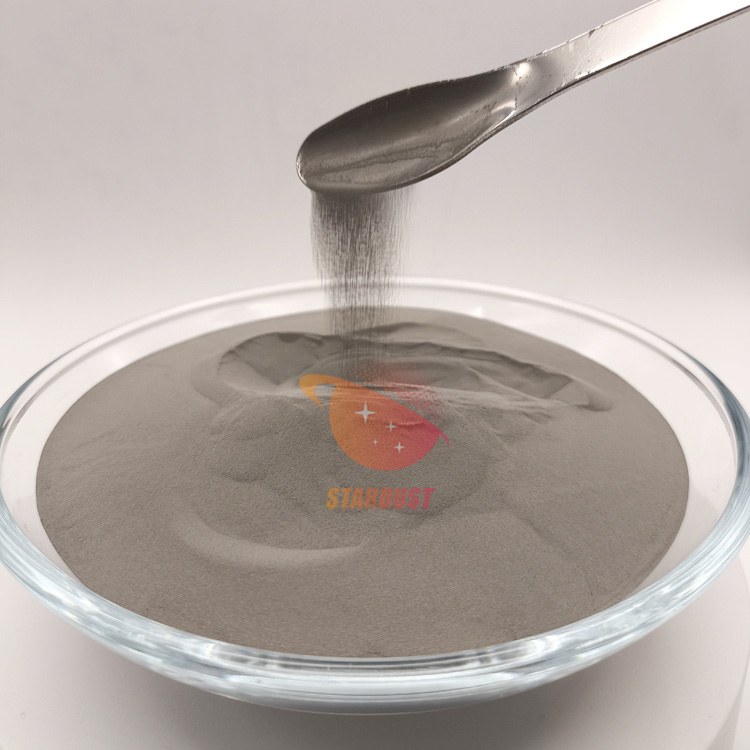
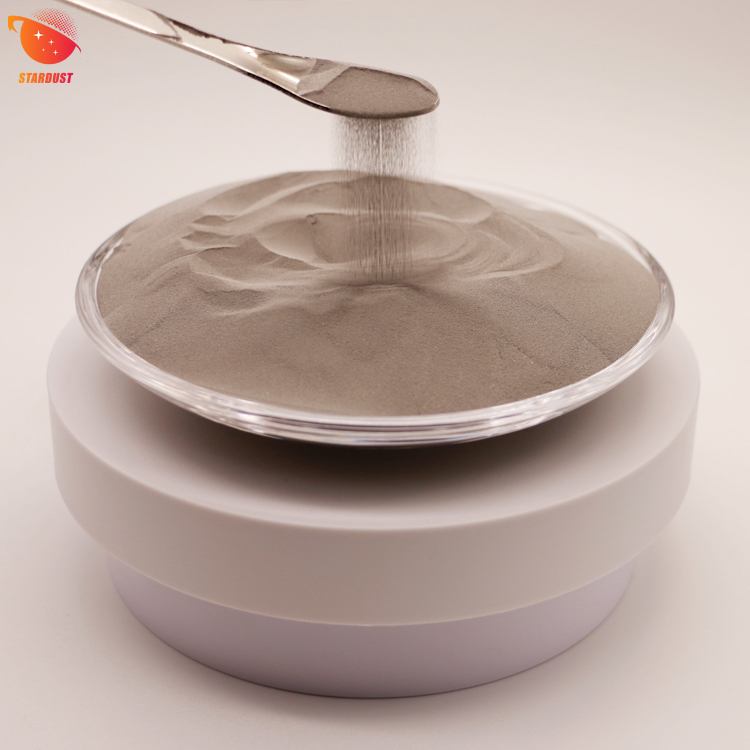
Based on spherical powders of rare refractory metals, Stardust Technology has built integrated solutions centered on 3D printing and Hot Isostatic Pressing (HIP) services. These solutions not only provide a scientific approach to optimizing the surface properties of spherical high-entropy alloy (HEA) powders, but also achieve full-chain quality controllability covering “powder production – surface treatment – 3D printing”.
In the future, with increasingly demanding requirements for refractory metal materials in high-end sectors such as aerospace, nuclear power and semiconductors, this full-chain collaborative model featuring “precise regulation of material properties” will become a core driving force for industrial upgrading. Stardust Technology will continue to deepen technological innovation and, through in-depth integration of products and services, provide customers with more efficient and high-quality solutions for spherical rare refractory metal powders and 3D printing services.
For more product information, please contact our sales manager:Manager DuanMobile: +86 13378621675




 IPv6 network supported