1. Introduction
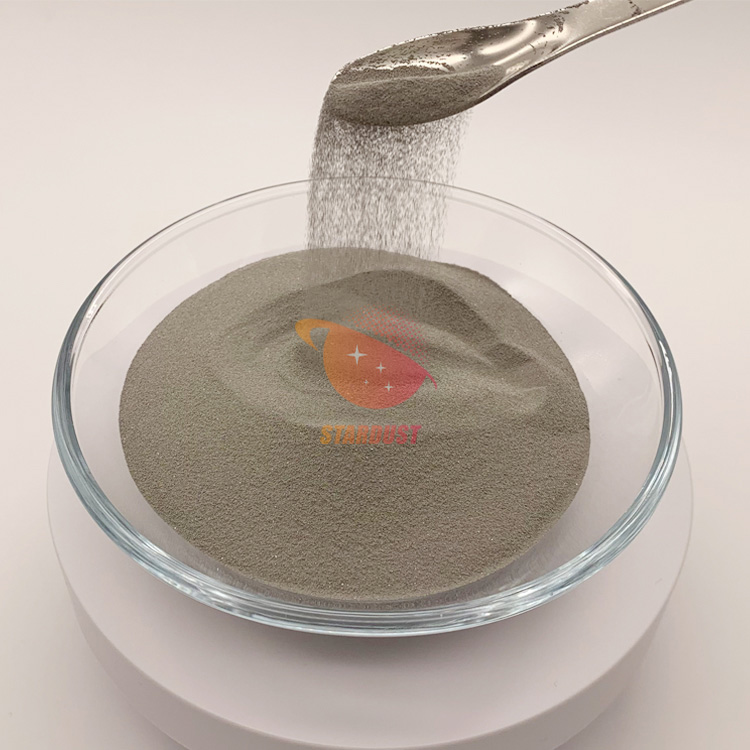
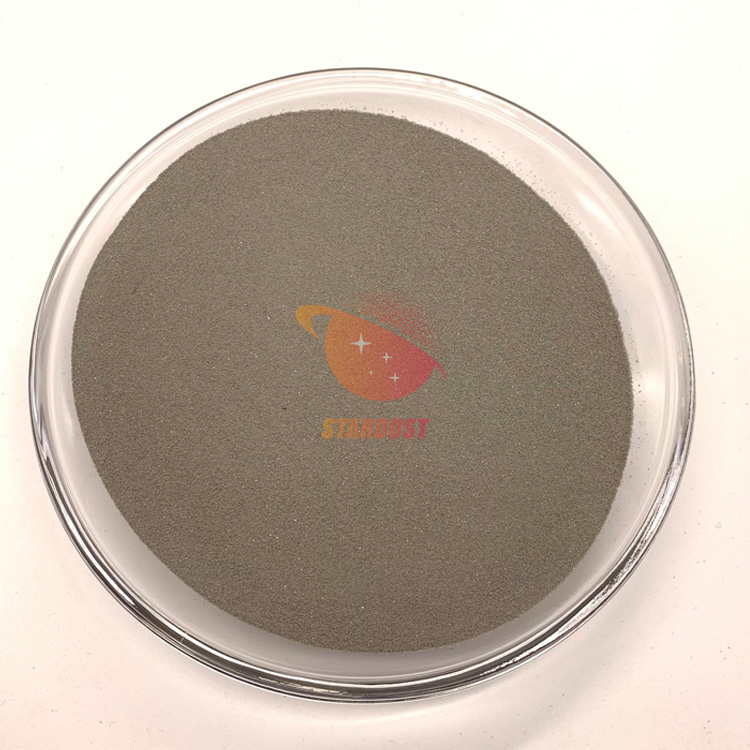
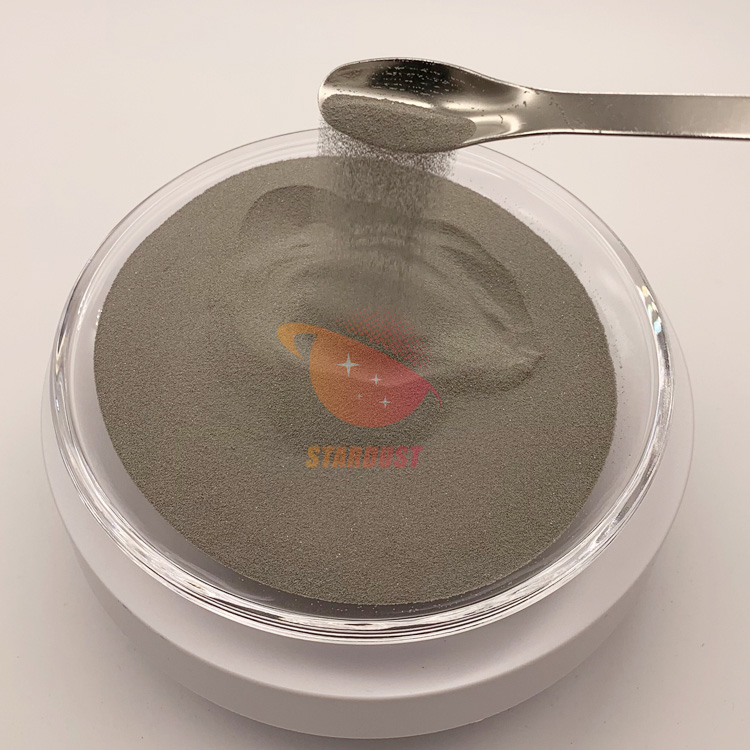
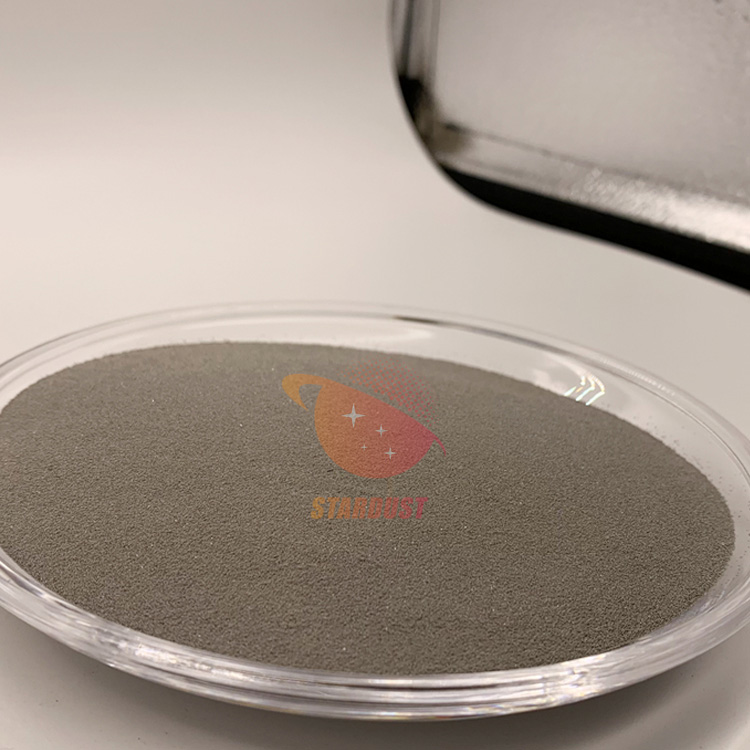
In recent years, with the continuous advancement of 3D printing technology, the field of powder metallurgy has garnered increasing attention. It is well known that among all elements and compounds in nature, chromium (Cr) and its compounds rank among the hardest metallic materials. Characterized by excellent chemical stability, high-temperature resistance, and low friction coefficients [1], chromium is widely applied in metallurgy, chemical engineering, electroplating, pharmaceuticals, textiles, and other industries [2–7]. Powders ground from metallic chromium and its oxides via mechanical methods can serve as light-resistant and heat-resistant coatings, abrasives, colorants for glass and ceramics, and materials for surface treatment processes such as electroplating and chromium diffusion [8, 9]. Currently, conventional powder production techniques yield irregularly shaped particles such as rods and lumps. This leads to poor flowability and low density in powder products, particularly for finer particles where agglomeration and poor dispersion are common, hindering large-scale application.
To enhance powder flowability and mitigate agglomeration, a highly effective approach involves transforming irregularly shaped powders into spherical particles. Spherical powders possess unique properties unattainable by conventional powders, such as superior flowability and high bulk density. Currently, spherical powder preparation methods primarily include the rotating electrode method, atomization method, and plasma method. While the rotating electrode method can produce powders with good sphericity, electrode wear leads to contamination of the powder products. Atomisation is primarily suited for low-melting-point powders, and the spherical powders produced by this method often exhibit defects such as voids. Consequently, for refractory metal powders, the plasma method proves to be a highly effective approach. To address this, this study employed the Inductively Coupled Thermal Plasma (ICTP) method to prepare spherical metallic chromium powder with a particle size ranging from 200 to 300 mesh. This method utilizes electromagnetic energy generated by an induction coil to ionize the gas (typically argon) flowing through it. Since the plasma is produced via electromagnetic induction, it enables the preparation of clean, spherical powder particles. Furthermore, the resulting plasma exhibits characteristics such as high temperature (up to 10,000 K), high enthalpy, and high energy density [10, 11], providing a high-temperature reaction environment for physicochemical reactions. Leveraging this feature enables greater effectiveness in the field of spherical powder preparation. The ICTP spherical powder preparation technology leverages its high-temperature properties. Any particles fed into the system undergo rapid contraction and shaping through the combined effects of surface tension and rapid quenching, driven by four heat transfer mechanisms: convection, conduction, radiation, and chemical processes. The resulting powder particles exhibit significantly improved flowability, characterized by excellent dispersibility and high sphericity, thereby effectively advancing developments in the field of powder metallurgy.
Therefore, this experiment employed a 100kW induction-coupled thermal plasma device to study the spheroidization treatment of metallic chromium powder with particle sizes ranging from 200 to 300 mesh. The influence of powder feeding rate on spheroidization efficiency was investigated, and the apparent morphology and flowability of the powder before and after spheroidization were characterized and analyzed.
2. Experimental Materials and Methods
2.1 Experimental Setup
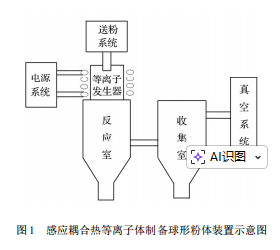
The GP100-DL-TLGP electron-tube induction-coupled power supply (manufactured by Tieling High-Frequency Induction Power Supply Factory) was employed as the plasma excitation source, operating at an oscillation frequency of 3.5 MHz and rated power of 100 kW. The powder feeding system utilized the PF-401 series disc feeder produced by TEKNA Inc. of Canada. The induction-coupled thermal plasma generator, gas supply system, gas-solid separation system, and vacuum system were independently developed. A schematic diagram of the experimental setup is shown in Figure 1.
2.2 Experimental Principle
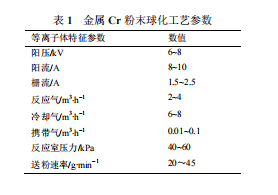
This experiment utilizes irregularly shaped metallic Cr powder with a particle size of 200–300 mesh, prepared via mechanical ball milling, as the raw material. The specific experimental procedure is as follows: First, activate the equipment to evacuate the entire system to approximately 35 kPa. Ignite the plasma generator to establish a stable plasma. Subsequently, feed the raw material powder into the plasma via a feeder. The introduced metallic chromium powder rapidly melts under the plasma's high temperature. During movement, the powder particles undergo convective heat transfer and conduction with the plasma. Under the influence of surface tension and rapid cooling, they contract and form shapes. Spherical powder is ultimately collected at the bottom of the reaction chamber, while finer particles are collected in the collection chamber. The powder feed rate is controlled by adjusting the vibration and rotational speed of the feeder. Specific experimental parameters are listed in Table 1.
2.3 Sample Characterization
The flowability of powder particles before and after spheroidization was measured using an FL 4-1 Hall flowmeter, while microstructure was observed via metallurgical microscope (OLYMPUS). For plasma powder spheroidization, the spheroidization rate K is a critical metric. The statistical method proposed in Reference [12] was employed to analyze the powder spheroidization rate during the experiment.

Where A is the total number of powder particles in a randomly selected region of the metallographic image, and B is the total number of spherical particles in that region.
3. Experimental Results and Discussion
3.1 Microstructural Characterization of Cr Powder Before and After Spheroidization
The metallographic micrograph of the raw Cr powder is shown in Figure 2. As seen in Figure 2, the raw Cr powder consists of highly irregular particles with a mesh size of approximately 200–300, exhibiting various structures such as blocky, angular, and rod-like shapes. Its surface is extremely rough and uneven, with non-uniform particle size and significant agglomeration. This raw powder may result in poor powder flowability.
Figure 3 presents the metallographic micrograph of the Cr powder after plasma spheroidization, magnified to the same level as the raw powder. As shown in Figure 3, the irregularly shaped raw powder particles undergo high-temperature plasma treatment, resulting in a more uniform morphology. The majority of particles now exhibit spherical or near-spherical shapes, achieving a spheroidization rate exceeding 80%.
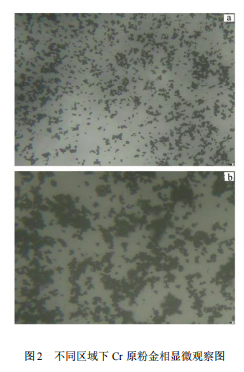
Figure 3 also reveals that some particles exhibit less dense surfaces with voids. This phenomenon primarily results from insufficient cooling and excessively slow cooling rates after particles exit the high-temperature plasma zone. Furthermore, the spheroidized powder particles show minimal agglomeration and excellent dispersion properties. This demonstrates that induction-coupled plasma technology effectively resolves powder agglomeration issues, thereby improving powder dispersibility.
Furthermore, compared to the original powder, the plasma-spherical powder exhibits increased particle size. This is primarily due to the fusion of molten droplets as particles move through the high-temperature plasma zone.
3.2 Flowability of Cr Powder Before and After Sphericalization
The Hall flowmeter was employed to measure the flowability of Cr powder before and after spheroidization. Results revealed that the original Cr powder exhibited extremely poor flowability—even percussion vibration of the funnel failed to induce flow, indicating virtually no inherent flowability. However, plasma spheroidization significantly enhanced powder flowability. Figure 4 illustrates the comparative flowability at different powder feed rates.
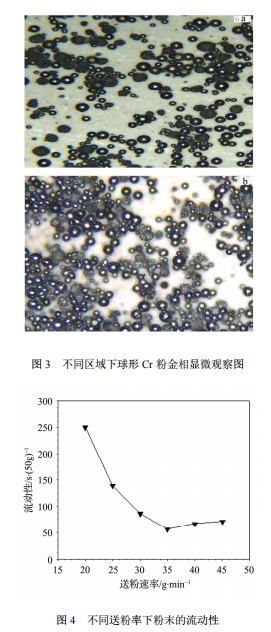
Figure 4 indicates that when the powder feed rate is below 35 g·min⁻¹, powder flowability improves with increasing feed rate. Conversely, when the feed rate exceeds 35 g·min⁻¹, further increases in feed rate deteriorate flowability. Analysis indicates that for chromium metal powder, optimal flow properties (approximately 56.18 s/50 g) are achieved at a feed rate of 35 g·min⁻¹. This is primarily because, for given plasma operating parameters, there exists a threshold for the processing capacity of spherical powder. Exceeding this threshold gradually diminishes the spheroidization effect. This occurs mainly because the plasma's processing capacity is limited when the powder feed rate is high. A large powder volume prevents the powder from absorbing sufficient heat within the plasma, resulting in poor spheroidization.
3.3 Effect of Powder Feed Rate on Spheroidization Rate
Experiments investigated the influence of different powder feed rates on spheroidization rate, as shown in Figure 5. As evident from Figure 5, the powder spheroidization rate increases with rising powder feed rate. At a feed rate of 35 g·min^(−1), the spheroidization rate reaches its maximum value exceeding 80%. Further increasing the feed rate causes the spheroidization rate to decline. Therefore, it can be concluded that the powder feed rate directly influences the spheroidization rate. This is primarily because at lower powder feed rates, powder particles absorb excessive heat from the plasma, leading to complete internal melting. Conversely, at higher feed rates, heat transfer efficiency decreases, preventing the plasma's high temperatures from melting the surfaces of some powder particles, which directly impacts the spheroidization rate.
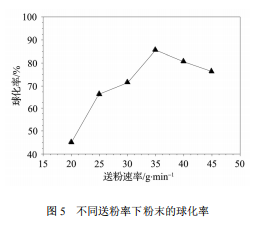
Furthermore, excessively high powder feed rates accelerate particle movement within the plasma, causing them to drift toward the generator's periphery. Since peripheral temperatures are lower than those at the generator's center, powder particles at the edges cannot be effectively heated, thereby impairing spheroidization.
Research indicates that an appropriate powder feed rate enhances both powder flowability and spheroidization rate. Therefore, after comprehensive evaluation of spherical powder collection rate and spheroidization rate, a powder feed rate of 35 g·min⁻¹ is optimal for 200–300 mesh metallic chromium, achieving the highest powder collection rate and spheroidization rate.
4. Conclusions
This study employed induction-coupled plasma powder preparation technology to investigate spheroidization of micron-sized powders, focusing on the effects of powder feed rate on spheroidization rate and flowability. The following conclusions were drawn:
(1) Leveraging the high-temperature characteristics of the inductively coupled plasma enables the production of spherical powders with high sphericity and excellent flowability;
(2) Both the flowability and spheroidization rate of spherical Cr powder improve with increasing powder feed rate, but both exhibit a threshold. Exceeding this threshold results in poorer flowability and spheroidization rate;
(3) For Cr raw powder with particle sizes around 200–300 mesh, maintaining a powder feed rate of approximately 35 g·min⁻¹ is optimal for achieving high spheroidization and collection rates.
Reference: Nuclear Fusion and Plasma Physics, Vol. 37, No. 2; Process Study on Spherical Chromium Powder Production via Inductively Coupled Plasma; Chen L.J. 1, Chen W.B. 1, 2, Liu C.D. 1, Cheng C.M. 1, Tong H.H. 1
The process study on spherical chromium powder production via inductively coupled plasma represents a key technological breakthrough in achieving high sphericity, high flowability, and high purity for chromium-based powders. The company's integrated solution—based on spherical powders of rare refractory metals and centered on 3D printing and customized forming services—not only provides reliable support for the large-scale production of high-quality spherical chromium powder but also achieves full-chain quality control spanning “raw materials → powder manufacturing processes → additive manufacturing.” Looking ahead, as demands for refractory metal materials continue to rise in aerospace, new energy, and high-end equipment sectors, high-performance spherical chromium powder will become a vital foundational material. The company will further deepen innovation in plasma-based powder production technology, seamlessly integrating products and services to deliver more efficient and superior spherical powders of rare refractory metals alongside comprehensive 3D printing solutions. For further product details, please contact our Sales Manager,Sukie Zhu, at +86 13378626726.




 IPv6 network supported